
A Master of Legal Studies, often called an MLS, MSL, or Master of Studies in Law, is designed for professionals who work with laws, regulations, contracts, compliance, employment issues, healthcare rules, public policy, risk management, or business operations—but who do not necessarily want to become attorneys.
Unlike a J.D., an MLS does not prepare graduates to sit for the bar exam or practice law. Instead, it gives non-lawyers a graduate-level understanding of legal systems and legal reasoning. That distinction matters: the ABA states that it does not accredit or approve non-J.D. degrees, and that its “acquiescence” in a law school’s non-J.D. program is not approval of the degree itself. Accreditation for non-J.D. programs generally come through the school’s or university’s institutional accreditor.
Legaldegree.org’s editorial approach is to help students choose legal degrees and law schools, explain the purpose of each program, and, where possible, use authoritative sources such as the ABA and BLS. With that in mind, this guide ranks online MLS programs based on law school reputation, flexibility, online delivery, specialization options, value, and usefulness for working professionals.
What Is an Online Master of Legal Studies?
An online Master of Legal Studies is a graduate degree for professionals who need legal knowledge but do not plan to become licensed attorneys. Programs commonly serve students in compliance, healthcare administration, human resources, contracts, finance, cybersecurity, government, education, real estate, nonprofit administration, and corporate operations.
The Princeton Review describes online MSL and MLS programs as programs for non-lawyers whose careers benefit from legal training, even though they are not required to be practicing attorneys. It also notes that many programs do not require the LSAT or GRE. Forbes Advisor similarly distinguishes the MLS from the LL.M., explaining that an LL.M. is typically for practicing attorneys, while MLS graduates generally work in legal-adjacent roles rather than as lawyers.
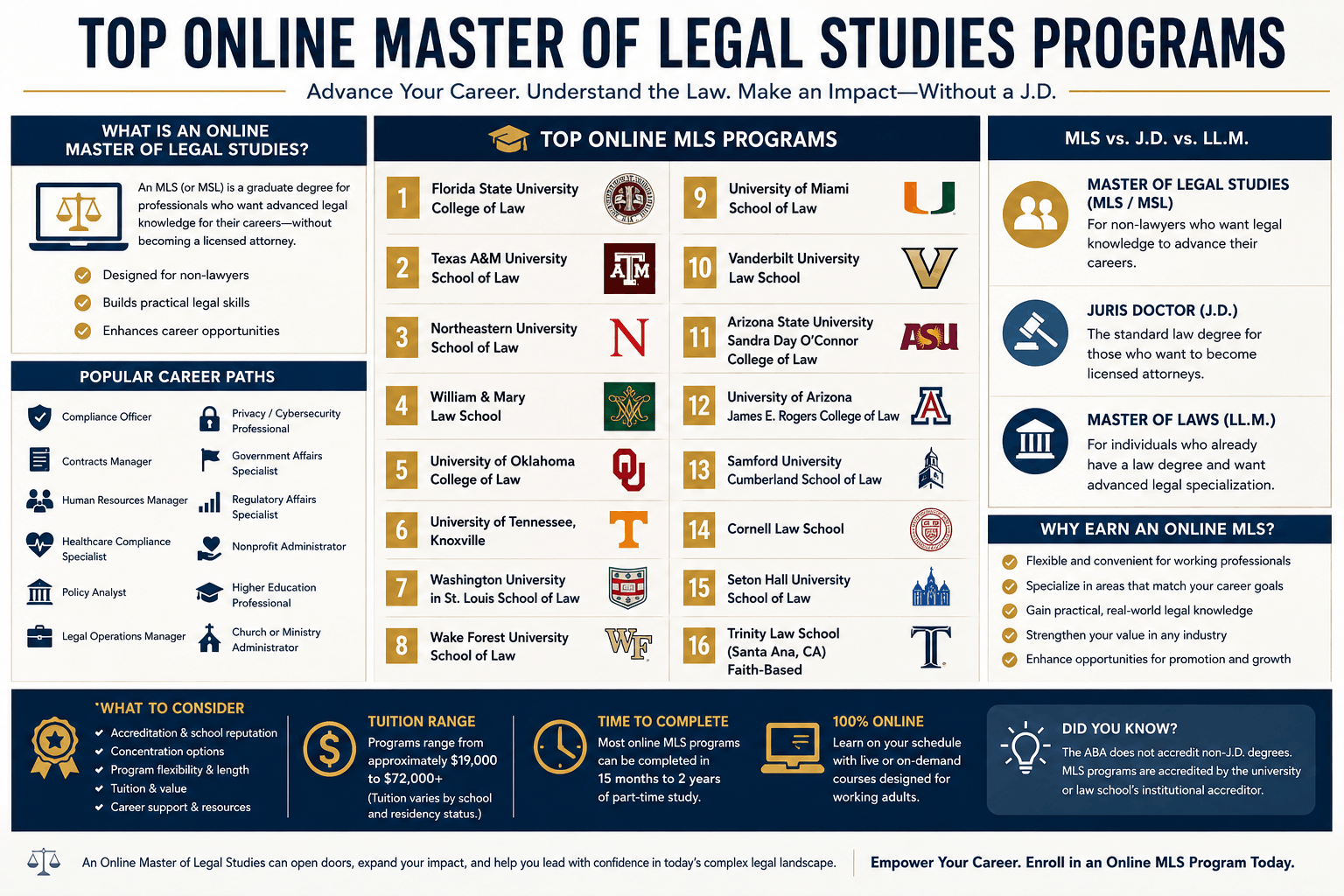
Top Online Master of Legal Studies Programs
1. Florida State University College of Law
Florida State University earns the top spot because it combines a respected public law school, strong affordability, and a practical online format for non-lawyers. Forbes Advisor identified FSU’s online MLS as a strong value option, especially for Florida residents, and listed its estimated in-state program cost at $20,490.
FSU is a strong choice for students who want a legal education tied to government, regulation, compliance, business, or public-sector work. Its public university pricing can make it especially appealing for students comparing return on investment across online legal studies programs.
Best for: Value-focused students, Florida residents, government, and compliance professionals.
2. Texas A&M University School of Law
Texas A&M University School of Law offers one of the most flexible online MLS options in the country. The Princeton Review lists Texas A&M’s online Master of Legal Studies and Master of Legal Studies in Intellectual Property as programs that can be completed in one to two years, requiring 30 credits. Forbes Advisor notes that Texas A&M offers an MLS with 13 tracks and labels it one of the most affordable choices for many students.
The breadth of concentration options makes Texas A&M especially useful for students who already know the industry they want to serve. A professional in healthcare, cybersecurity, employment, intellectual property, risk management, or business law can tailor the degree more closely than at many peer programs.
Best for: Students who want many specialization options, especially in business, IP, compliance, and regulated industries.
3. Northeastern University School of Law
Northeastern University’s online MLS stands out for its professional orientation and concentration options. The Princeton Review describes Northeastern’s online MLS as a program for non-lawyers that includes a general path plus concentrations in Business Law, Health Law, Human Resource Law, Intellectual Property Law, and Public Law and Policy. Forbes Advisor also highlights Northeastern’s MLS with five concentrations and identifies it as strong for alumni earnings.
Northeastern is a good fit for working adults who want legal knowledge tied directly to professional advancement. Its concentrations align well with common MLS career outcomes: HR, compliance, healthcare administration, IP management, policy, and corporate operations.
Best for: Working professionals seeking career mobility and practical legal training.
4. William & Mary Law School
William & Mary offers a respected name in legal education and a strong online MLS option for students who want a traditional law-school brand with flexible delivery. Forbes Advisor lists William & Mary among its top online MLS programs and notes that the program offers four concentrations, with an estimated program-specific tuition of $41,216.
William & Mary is a particularly attractive option for students who want a program connected to one of the nation’s oldest and most recognizable public universities. It may appeal to professionals in government, contracts, compliance, policy, business, and public administration settings.
Best for: Students who value law school reputation and a structured set of concentrations.
5. University of Oklahoma College of Law
The University of Oklahoma offers one of the more distinctive online legal studies programs because of its concentration areas. The Princeton Review lists the University of Oklahoma’s Master of Legal Studies as a program that can be completed in 15 to 18 months, with concentrations including Oil, Gas, and Energy Law, Indigenous Peoples Law, International Business Law, and Healthcare Law. Forbes Advisor also lists Oklahoma as one of the lower-cost programs, with estimated program-specific tuition of $19,616.
This program is especially compelling for students whose careers intersect with energy, tribal law, healthcare, or international business. Those are not generic MLS concentrations; they reflect real regulatory environments where legal knowledge can be professionally valuable.
Best for: Energy, healthcare, Indigenous law, and international business professionals.
6. University of Tennessee, Knoxville
The University of Tennessee, Knoxville, offers a practical online MLS option with a particularly attractive price point for in-state students. Forbes Advisor lists the University of Tennessee’s online Master of Legal Studies with an estimated in-state program-specific tuition of $19,170 and identifies it as a strong deal for Tennessee residents.
Tennessee’s program is a good fit for students who want a broad legal foundation without taking on the cost of some private-university online MLS programs. It may be especially useful for professionals in business, compliance, HR, contracts, government, nonprofit leadership, and corporate administration.
Best for: Tennessee residents and cost-conscious students seeking a broad MLS.
7. Washington University in St. Louis School of Law
Washington University in St. Louis offers a prestigious private-university option for students who want a collaborative online legal education. Forbes Advisor lists WashU’s online MLS with five concentrations and describes it as best for collaborative learning, with estimated program-specific tuition of $72,792.
WashU may be best for students who prioritize institutional prestige, strong academic design, and a more interactive online environment. The higher tuition means applicants should carefully compare employer tuition benefits, scholarship opportunities, and expected career impact.
Best for: Students seeking a highly regarded private law school and collaborative online learning.
8. Wake Forest University School of Law
Wake Forest University offers an online MLS that may appeal to students who want graduate legal education plus stackable or complementary certificate options. Forbes Advisor lists Wake Forest’s Master of Legal Studies among its top programs and identifies it as best for graduate certificates, with estimated program-specific tuition of $36,660.
Wake Forest’s structure can be useful for students who want targeted legal knowledge but are not fully sure whether they need a complete master’s degree at the outset. Certificate pathways can also be useful for professionals who want to document expertise in a specific area.
Best for: Students interested in certificates, flexible credentialing, or targeted professional development.
9. University of Miami School of Law
The University of Miami offers an online MLS with multiple specialized tracks. Forbes Advisor lists Miami’s Master of Legal Studies with six specialized tracks and identifies it as strong for socio-economic mobility, with estimated program-specific tuition of $40,440.
Miami is a good choice for students who want specialization and a private law school with a strong regional brand. Its location and professional network may be especially relevant for students interested in healthcare, sports, business, real estate, entertainment, compliance, and Latin America–related legal issues, depending on the track selected.
Best for: Students seeking specialized tracks and a strong private-university brand.
10. Vanderbilt University Law School
Vanderbilt rounds out the top 10 as a high-prestige option with a strong student-to-faculty profile. Forbes Advisor lists Vanderbilt’s online Master of Legal Studies and identifies it as having the lowest student-to-faculty ratio among its ranked programs, with estimated program-specific tuition of $57,060.
Vanderbilt may be a strong fit for students who want a selective private university, a nationally respected law school, and a more personal academic environment. As with WashU, prospective students should weigh the higher tuition against career goals, employer reimbursement, and the value of the Vanderbilt name in their field.
Best for: Students who want a prestigious law school and potentially smaller-scale academic support.
11. Arizona State University Sandra Day O’Connor College of Law
Arizona State University offers a flexible online Master of Legal Studies through the Sandra Day O’Connor College of Law. The program is designed for professionals who want to understand U.S. law without pursuing a full law degree, making it a strong fit for students in compliance, business, human resources, government, healthcare, contracts, and other legal-adjacent roles.
ASU’s online MLS requires 30 credit hours across 10 classes, with courses offered in 7.5-week sessions. Students begin with foundational legal training and then customize the degree through electives or one of 12 available emphases. The program is especially useful for students who want a broad legal foundation but also want room to tailor the curriculum to a specific career path.
<>ASU also notes that online diplomas and transcripts simply say “Arizona State University,” rather than specifying online delivery.
Best for: Students who want a flexible, customizable online MLS from a large public university with a nationally recognized law school.
12. University of Arizona James E. Rogers College of Law
The University of Arizona deserves a place in the main lineup because of the breadth of its online MLS concentrations. The Princeton Review lists Arizona’s online MLS as offering a wide range of tracks, including Compliance and Legal Risk Management, Criminal Law and Policy, Environmental Law and Policy, Family and Juvenile Law, Health Law and Policy, Human Rights, Indigenous Peoples Law and Policy, Intellectual Property, International Trade and Business Law, Mining Law and Policy, and Tax Law and Policy.
That variety makes Arizona one of the better options for students whose professional goals do not fit neatly into a generic “business law” or “compliance” track. It may be especially attractive for students in the Southwest, students working in public-sector or tribal contexts, and professionals in industries such as mining, trade, tax, health, and environmental regulation.
Best for: Students who want many concentration choices, especially in public policy, Indigenous law, environmental law, tax, and regulated industries.
13. Samford University Cumberland School of Law
Samford University’s Cumberland School of Law offers a Master of Studies in Law that can be completed online and is designed for professionals who need legal knowledge in specialized fields. The Princeton Review lists Cumberland’s MSL as a program that can be completed in two years and includes concentrations such as Financial Services Regulatory Compliance, Health Law and Compliance, Higher Education Law and Compliance, Legal Operations, and a custom option.
Cumberland is a strong option for students who want a legal studies program closely tied to compliance and operations. The inclusion of higher education law and legal operations helps distinguish it from programs that focus more narrowly on business law or general legal studies.
Best for: Compliance, higher education, healthcare, financial services, and legal operations professionals.
14. Cornell Law School
Cornell Law School offers one of the most prestigious names in this category. The Princeton Review lists Cornell’s Online Master of Science in Legal Studies as a 30-credit program that can be completed in 20 months.
Cornell may appeal most to students who want an Ivy League legal education without pursuing a J.D. The program’s brand recognition can be valuable for professionals in business, compliance, human resources, technology, healthcare, and leadership roles where legal literacy is increasingly important.
Because Cornell is likely to be a premium-priced option compared with many public-university MLS programs, applicants should weigh the cost against their career goals, employer reimbursement, and the value of Cornell’s name in their industry.
Best for: Students seeking an Ivy League legal studies credential and strong institutional brand recognition.
15. Seton Hall University School of Law
Seton Hall Law offers a highly specialized online MLS option, particularly for students interested in compliance-heavy industries. The Princeton Review lists Seton Hall’s online MLS concentrations as Corporate Compliance, General Legal Studies, Health and Hospital Law, Sports Law and Compliance, Gaming Regulation and Compliance, and Pharmaceutical and Medical Device Law and Compliance.
This is one of the more industry-targeted programs in the online MLS market. Seton Hall’s health, pharmaceutical, medical device, gaming, and sports compliance options may be especially useful for professionals who already work in one of those fields and want legal training that maps directly onto their career path.
Best for: Healthcare, pharmaceutical, medical device, sports, gaming, and corporate compliance professionals.
16. Trinity Law School
Trinity Law School in Santa Ana, California, offers an online Master of Legal Studies taught from a distinctly Christian worldview. Trinity describes its MLS as a program designed to help students understand legal documents, proceedings, and rights, with all courses taught online in 8-week cycles. Its program offers a general MLS as well as optional tracks including Alternative Dispute Resolution, Church Administration, Contracts and Negotiation, Criminal Justice, Human Resources Management, Human Rights, Human Trafficking Advocacy, Ministry, Advocacy, and the Law, Nonprofit Administration, Paralegal, and a Customized Plan of Study.
Trinity is a particularly distinctive option because it is faith-based. The school describes its legal education as rooted in the historic Judeo-Christian tradition and frames legal education as a calling to put faith into action. That makes it a potentially strong fit for students who want legal studies connected to ministry, nonprofit work, church administration, advocacy, human trafficking prevention, or faith-informed public service.
Best for: Students seeking a faith-based online MLS, especially those interested in church administration, ministry, nonprofit leadership, advocacy, human rights, human trafficking advocacy, or Christian legal studies.
How We Ranked These Programs
This ranking considered:
- Law school and university reputation
- Online flexibility for working adults
- Concentration options
- Estimated tuition and value
- Career relevance for non-lawyer professionals
- Evidence from reputable third-party rankings and program directories
- Alignment with legal-adjacent career paths such as compliance, HR, contracts, policy, healthcare, nonprofit leadership, and risk management
Because the ABA does not rank law schools and explicitly states that it does not endorse or provide data to any law school ranking system, students should treat rankings as a starting point—not a substitute for individual research.
What Can You Do With an Online Master of Legal Studies?
An MLS can support careers in fields where legal knowledge matters, but a law license is not required. Common paths include:
- Compliance officer
- Contracts manager
- Human resources manager
- Risk analyst
- Healthcare compliance specialist
- Policy analyst
- Legal operations manager
- Privacy or cybersecurity compliance professional
- Government affairs specialist
- Regulatory affairs specialist
- Nonprofit administrator
- Higher education compliance professional
- Church or ministry administrator
- Human rights or advocacy program manager
The broader legal field remains a meaningful employment category. The BLS reports that legal occupations involve interpreting the law and supporting law-related activities, and projects about 83,800 openings per year in legal occupations from 2024 to 2034. However, MLS students should remember that many MLS-relevant jobs fall outside the BLS “legal occupations” category, especially in compliance, HR, healthcare administration, finance, nonprofit management, higher education, and corporate operations.
MLS vs. J.D. vs. LL.M.
A Master of Legal Studies is usually for non-lawyers who want legal knowledge for professional use.
A Juris Doctor is the standard law degree for students who want to become attorneys.
An LL.M., or Master of Laws, is generally for people who already have a law degree and want advanced legal specialization.
This distinction is critical. Students who want to practice law should generally pursue a J.D., not an MLS. Students who want to understand law for business, compliance, policy, HR, administration, advocacy, ministry, or nonprofit work may find the MLS more efficient and career-relevant.
How to Choose the Right Online MLS Program
Start with your career goal. A healthcare administrator should prioritize health law and compliance. A technology professional may want privacy, cybersecurity, intellectual property, or legal operations. An HR professional should look for employment law and workplace compliance. A public-sector professional may benefit from administrative law, policy, or government-focused coursework. Students interested in ministry, church administration, or faith-based advocacy may want to consider whether a Christian legal studies environment, such as Trinity Law School’s, matches their values and goals.
Then compare practical factors: tuition, employer reimbursement, time to completion, asynchronous versus live classes, faculty access, concentration depth, student support, and whether the program is housed in a law school with strong academic resources.
Finally, confirm the accreditation language carefully. A law school may be ABA-approved for its J.D. program, but the ABA does not approve the MLS itself. For non-J.D. programs, students should look at the university’s institutional accreditation, the law school’s disclosures, and whether the degree fits their intended career path.
Similar Resources
10 Career Outcomes for Graduates with a Master of Legal Studies
Sources
American Bar Association – Non-JD and Post-JD Programs by School
American Bar Association – Non-JD Programs
American Bar Association – ABA-Approved Law Schools
U.S. Bureau of Labor Statistics – Legal Occupations
The Princeton Review – Best Online Master’s in Studies in Law Programs