

A Master of Legal Studies, often called an MLS, MSL, or Master of Studies in Law, is designed for professionals who want advanced legal knowledge without becoming licensed attorneys. Unlike a Juris Doctor, an MLS generally does not qualify graduates to sit for the bar exam or practice law. Instead, it helps students understand legal systems, regulations, contracts, risk, compliance, and policy in ways that can strengthen careers in business, healthcare, government, education, human resources, technology, and nonprofit leadership.
For students considering legal education but not necessarily aiming for courtroom practice, the MLS can be a practical middle ground: more legally focused than an MBA or MPA, but usually shorter and less practice-oriented than a JD.
LegalDegree.org publishes educational guides that help students choose the right legal degree and law school, with an emphasis on explaining the degree’s purpose, program fit, and career outcomes. The project guidance also prioritizes authoritative sources such as the American Bar Association and the U.S. Bureau of Labor Statistics when discussing legal education and employment outcomes.
What Is a Master of Legal Studies?
A Master of Legal Studies is a graduate degree for non-lawyers who regularly interact with legal issues in their work. MLS students typically study subjects such as:
- U.S. legal systems
- Contracts
- Compliance
- Employment law
- Health law
- Privacy and cybersecurity law
- Business law
- Administrative law
- Risk management
- Regulatory policy
- Ethics and professional responsibility
Programs vary widely. Some are general legal studies degrees, while others offer concentrations in areas such as healthcare compliance, human resources law, cybersecurity, tax, financial regulation, or business law.
The American Bar Association notes an important distinction for students: the ABA Council does not accredit or approve non-JD degrees itself, even when ABA-approved law schools offer those programs. Its review process for non-JD programs focuses on whether the program interferes with the law school’s ability to meet ABA standards for its JD program.
That means prospective students should evaluate MLS programs carefully by looking at the law school’s reputation, curriculum, faculty, career support, flexibility, cost, and whether the degree aligns with their intended career path.
Who Is an MLS Degree Best For?
An MLS is often best suited for professionals who do not want to become attorneys but who need to work confidently with laws, regulations, contracts, or legal risk. Common MLS students include:
- Compliance professionals
- Human resources professionals
- Healthcare administrators
- Contract managers
- Government employees
- Law enforcement or public safety professionals
- Financial services professionals
- Entrepreneurs and business managers
- Nonprofit leaders
- Legal operations professionals
- Privacy, cybersecurity, or data governance professionals
The degree can also appeal to career changers who want to move into legal-adjacent work without committing to the time, cost, and licensing requirements of a JD.
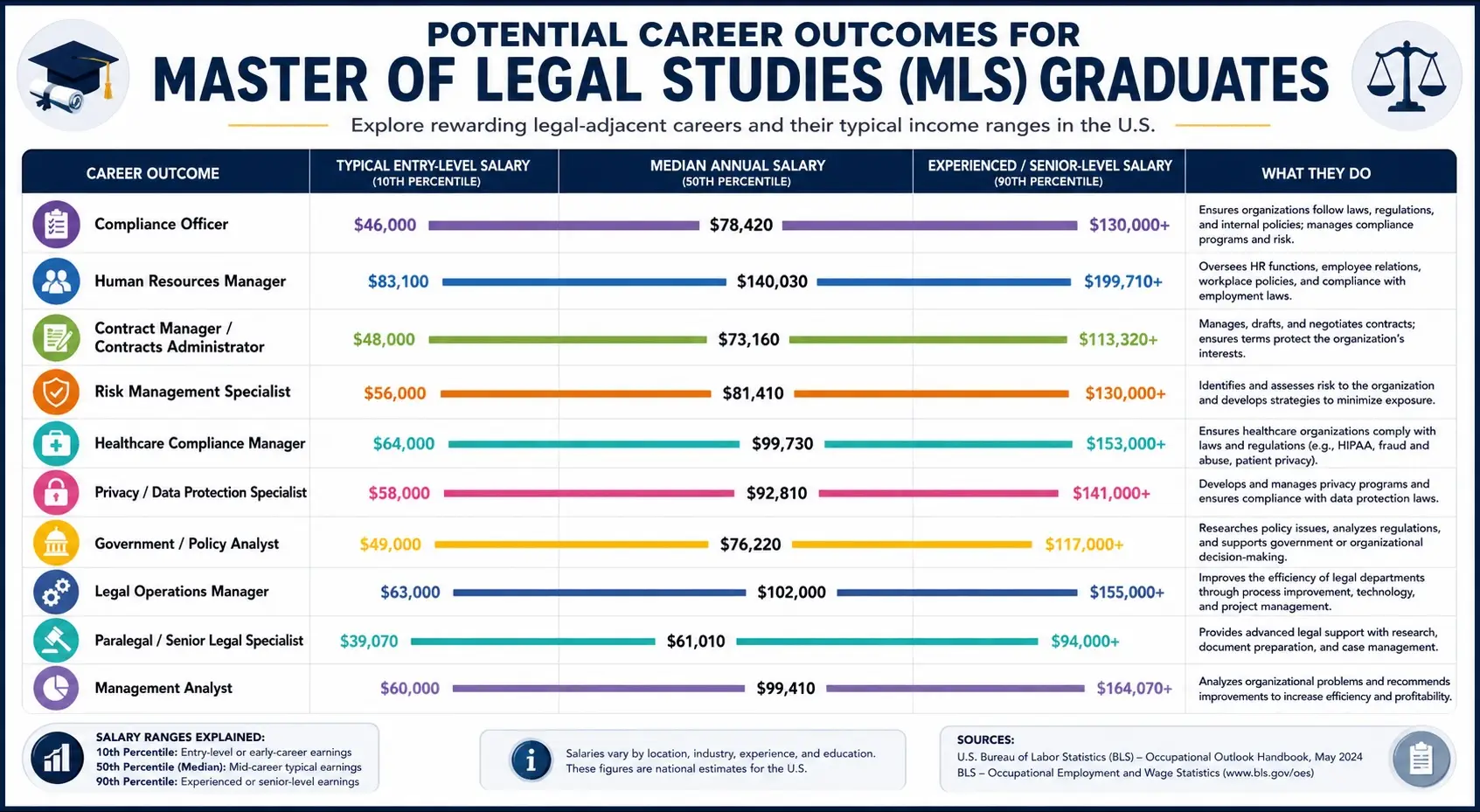
Career Outcomes for MLS Graduates
Compliance Officer
Compliance is one of the most common and practical career paths for MLS graduates. Compliance officers help organizations follow laws, regulations, internal policies, and industry standards. They may work in banking, healthcare, insurance, education, energy, technology, pharmaceuticals, or government.
Typical responsibilities include monitoring regulatory changes, developing internal policies, conducting audits, training employees, investigating potential violations, and advising leadership on risk.
The legal training from an MLS can be especially useful because compliance professionals must interpret rules, communicate requirements clearly, and help organizations avoid penalties. According to the Bureau of Labor Statistics, compliance officers earned a median annual wage of $78,420 in May 2024, with employment projected to grow 3% from 2024 to 2034.
Legal Operations Specialist or Manager
Legal operations is a growing field focused on making legal departments more efficient. Legal operations professionals manage budgets, outside counsel relationships, technology platforms, vendor contracts, workflows, reporting, and process improvement.
An MLS can be useful in this role because legal operations professionals need to understand how legal teams work, even if they are not providing legal advice. Graduates with backgrounds in project management, business operations, finance, or technology may be especially well positioned.
This path may lead to roles such as:
- Legal operations analyst
- Legal operations manager
- Legal project manager
- Contract lifecycle management specialist
- E-discovery operations specialist
- Legal technology implementation manager
The related JD-focused career guide in this project notes that legal technology and legal operations roles are attractive for legally trained professionals who enjoy efficiency, technology, and innovation rather than direct legal practice.
Human Resources Manager or Employee Relations Specialist
Human resources professionals regularly deal with employment law, workplace investigations, benefits rules, wage and hour issues, discrimination claims, employee handbooks, and termination procedures. An MLS with a concentration in employment law or HR compliance can help HR professionals manage these responsibilities with greater confidence.
MLS graduates may pursue roles such as:
- HR compliance specialist
- Employee relations manager
- Labor relations specialist
- Workplace investigations specialist
- Benefits compliance manager
- HR policy manager
BLS data shows that human resources specialists earned a median annual wage of $72,910 in May 2024, with employment projected to grow 6% from 2024 to 2034, faster than the average for all occupations.
For professionals already working in HR, the MLS may serve less as an entry-level credential and more as a career accelerator for roles involving policy, compliance, investigations, or leadership.
Contract Manager or Contracts Administrator
Contract-focused roles are another strong fit for MLS graduates. Contract managers help organizations draft, review, organize, negotiate, and monitor agreements. They may work with vendor agreements, procurement contracts, employment agreements, service contracts, licensing deals, leases, or government contracts.
Although MLS graduates are not attorneys, they can bring valuable legal literacy to contract-heavy environments. They may help identify business risks, track obligations, manage approval workflows, and coordinate with in-house or outside counsel when legal interpretation is needed.
Common job titles include:
- Contracts administrator
- Contract manager
- Procurement contract specialist
- Vendor management specialist
- Commercial contracts analyst
- Government contracts specialist
This career path may be especially useful for professionals in business, supply chain, healthcare administration, government procurement, or technology.
Healthcare Compliance Manager
Healthcare is one of the most regulated sectors in the U.S. Professionals in hospitals, insurance companies, clinics, pharmaceutical companies, and healthcare technology firms must navigate laws and rules related to privacy, billing, fraud and abuse, licensing, reimbursement, patient rights, and data security.
An MLS with a healthcare law or compliance concentration can support careers such as:
- Healthcare compliance officer
- HIPAA privacy officer
- Patient safety compliance specialist
- Risk management coordinator
- Clinical research compliance specialist
- Regulatory affairs specialist
This path may be particularly strong for nurses, healthcare administrators, medical office managers, insurance professionals, or public health workers who want to move into compliance or leadership roles.
Privacy, Cybersecurity, and Data Governance Professional
As organizations collect and store more personal data, privacy and cybersecurity laws have become increasingly important. MLS graduates with coursework in privacy law, cybersecurity law, or technology regulation may pursue roles involving data governance, incident response, privacy compliance, and internal policy development.
Potential job titles include:
- Privacy analyst
- Data protection specialist
- Cybersecurity compliance analyst
- Information governance manager
- Privacy program manager
- Governance, risk, and compliance analyst
These roles often require cross-functional work with legal, IT, security, compliance, and business teams. An MLS can be useful because professionals must understand legal obligations while translating them into practical policies and procedures.
Risk Management Specialist
Risk management professionals help organizations identify, assess, and reduce legal, operational, financial, reputational, and regulatory risks. An MLS can support this work by strengthening a graduate’s understanding of liability, compliance, governance, contracts, and regulatory exposure.
Possible roles include:
- Enterprise risk analyst
- Operational risk manager
- Insurance risk specialist
- Corporate governance analyst
- Internal controls specialist
- Third-party risk manager
Graduates with backgrounds in finance, insurance, business administration, or compliance may find the MLS especially relevant for risk-focused career advancement.
Government or Public Sector Administrator
Government agencies need professionals who understand statutes, regulations, administrative procedures, procurement rules, public records requirements, ethics obligations, and policy implementation. MLS graduates may work in federal, state, or local government roles where legal literacy is valuable but bar admission is not required.
Potential outcomes include:
- Policy analyst
- Legislative analyst
- Program manager
- Regulatory compliance specialist
- Public administration manager
- Agency operations specialist
This can be a good fit for professionals who want to work at the intersection of law, policy, and public service without practicing as attorneys.
Policy Analyst or Legislative Specialist
An MLS can also prepare graduates for policy-oriented roles in think tanks, advocacy organizations, trade associations, nonprofits, and government offices. These professionals research legal and regulatory issues, draft policy briefs, analyze proposed legislation, and help organizations understand how new laws may affect them.
MLS graduates may be well suited for this field because legal education emphasizes reading complex texts, identifying key issues, and explaining consequences clearly.
Common job titles include:
- Policy analyst
- Legislative affairs specialist
- Government affairs associate
- Regulatory policy analyst
- Advocacy manager
- Public affairs specialist
For students interested in this path, it is helpful to choose MLS programs with coursework in administrative law, legislation, public policy, constitutional law, or a relevant subject area such as healthcare, education, labor, environment, or technology.
Paralegal or Senior Legal Support Role
Some MLS graduates may work in legal support roles, although students should be careful not to assume that an MLS is required for paralegal work. Many paralegals enter the field through associate degrees, bachelor’s degrees, certificates, or on-the-job experience.
Still, for experienced paralegals or legal assistants, an MLS may help support advancement into senior, specialized, or management-oriented roles. Potential job titles include:
- Senior paralegal
- Litigation support manager
- Legal analyst
- Legal research specialist
- Practice support manager
- Compliance paralegal
BLS reports that paralegals and legal assistants earned a median annual wage of $61,010 in May 2024, with about 39,300 openings projected each year from 2024 to 2034 despite limited overall employment growth.
Business Manager, Entrepreneur, or Corporate Leader
For business professionals, an MLS can provide a stronger foundation in contracts, employment law, compliance, intellectual property, corporate governance, and risk management. This can be useful for managers, founders, executives, and department heads who regularly make decisions with legal consequences.
An MLS may support roles such as:
- Operations manager
- Business compliance manager
- Startup founder
- Corporate governance specialist
- Vendor relations manager
- Director of administration
- Chief operating officer in a regulated organization
The degree may be especially valuable in industries where legal and regulatory issues are central to business strategy, such as finance, healthcare, insurance, education, real estate, technology, and government contracting.
What an MLS Does Not Usually Prepare You To Do
A Master of Legal Studies is not the same as a Juris Doctor. In most cases, MLS graduates cannot:
- Practice law
- Represent clients in court
- Give legal advice as attorneys
- Sit for the bar exam based only on the MLS
- Use the title “lawyer” or “attorney.”
This distinction is critical. Students who want to become practicing attorneys should generally pursue a JD, not an MLS. Students who want legal knowledge for business, compliance, policy, HR, or administrative roles may find the MLS more aligned with their goals.
Is an MLS Worth It?
An MLS may be worth it for students who already know how legal knowledge will improve their career path. The degree is often strongest when paired with existing professional experience. For example, a healthcare administrator who earns an MLS in health law may become more competitive for compliance leadership roles. An HR professional who studies employment law may be better prepared for employee relations or workplace investigations. A cybersecurity professional who studies privacy law may be better positioned for governance, risk, and compliance roles.
However, the MLS is not automatically worth it for everyone. Prospective students should consider:
- Total tuition and fees
- Whether the program is online, hybrid, or in person
- Whether the law school has strong career services for non-JD students
- Whether concentrations match the student’s career goals
- Whether employers in the target field value the credential
- Whether a certificate, an MBA, an MPA, or an industry certification would be more useful
- Whether the student wants legal knowledge or the ability to practice law
The best MLS candidates usually have a clear career reason for pursuing the degree.
How to Choose an MLS Program Based on Career Goals
Students should start by identifying the type of legal knowledge they need. For example:
| Career Goal | Helpful MLS Concentration or Coursework |
|---|---|
| Compliance officer | Compliance, administrative law, corporate compliance, ethics |
| HR manager | Employment law, labor law, workplace investigations |
| Healthcare administrator | Health law, HIPAA, healthcare compliance, bioethics |
| Privacy professional | Privacy law, cybersecurity law, data governance |
| Contract manager | Contracts, business law, procurement, negotiation |
| Policy analyst | Legislation, administrative law, public policy |
| Legal operations manager | Legal technology, project management, business law |
| Risk manager | Corporate governance, compliance, insurance, and financial regulation |
Students should also look for programs that offer practical assignments, industry-relevant electives, faculty with professional experience, and networking opportunities with employers in their target field.
Bottom Line
A Master of Legal Studies can lead to a wide range of legal-adjacent careers, especially in compliance, human resources, healthcare administration, privacy, risk management, contracts, policy, and legal operations. It is not a substitute for a JD and does not typically lead to attorney licensure, but it can be a valuable credential for professionals who need to understand the law without practicing law.
For the right student, the MLS offers a focused way to gain legal fluency, improve decision-making, and move into roles where law, regulation, and business strategy overlap.
Similar Resources
Sources
American Bar Association – Non-JD and Post-JD Programs by School
U.S. Bureau of Labor Statistics – Compliance Officers
U.S. Bureau of Labor Statistics – Human Resources Specialists
U.S. Bureau of Labor Statistics – Human Resources Managers
U.S. Bureau of Labor Statistics – Paralegals and Legal Assistants
U.S. Bureau of Labor Statistics – Arbitrators, Mediators, and Conciliators
U.S. Bureau of Labor Statistics – Medical and Health Services Managers
U.S. Bureau of Labor Statistics – Management Analysts
U.S. Bureau of Labor Statistics – Financial Examiners
U.S. Bureau of Labor Statistics – Occupational Outlook Handbook
U.S. Bureau of Labor Statistics – Occupational Employment and Wage Statistics
University of Pennsylvania Carey Law School – Master in Law Program
Northwestern Pritzker School of Law – Master of Science in Law Curriculum
American University Washington College of Law – Online Master of Legal Studies Curriculum