

Top 5 Master of Legal Studies Programs for Human Resources Professionals
Human resources is no longer just a people-management function. Today’s HR professionals are often expected to understand employment law, workplace investigations, benefits compliance, discrimination claims, wage-and-hour rules, labor relations, privacy issues, and organizational risk. That is why many HR managers, employee relations specialists, compliance officers, and talent leaders are considering a Master of Legal Studies, or similar non-JD legal master’s degree, focused on employment and human resources law.
Unlike a Juris Doctor, an MLS is generally designed for professionals who do not plan to become attorneys. Instead, it gives non-lawyer professionals practical legal knowledge they can use in their existing field. For HR professionals, that legal foundation can be especially valuable because workplace decisions often carry legal consequences.
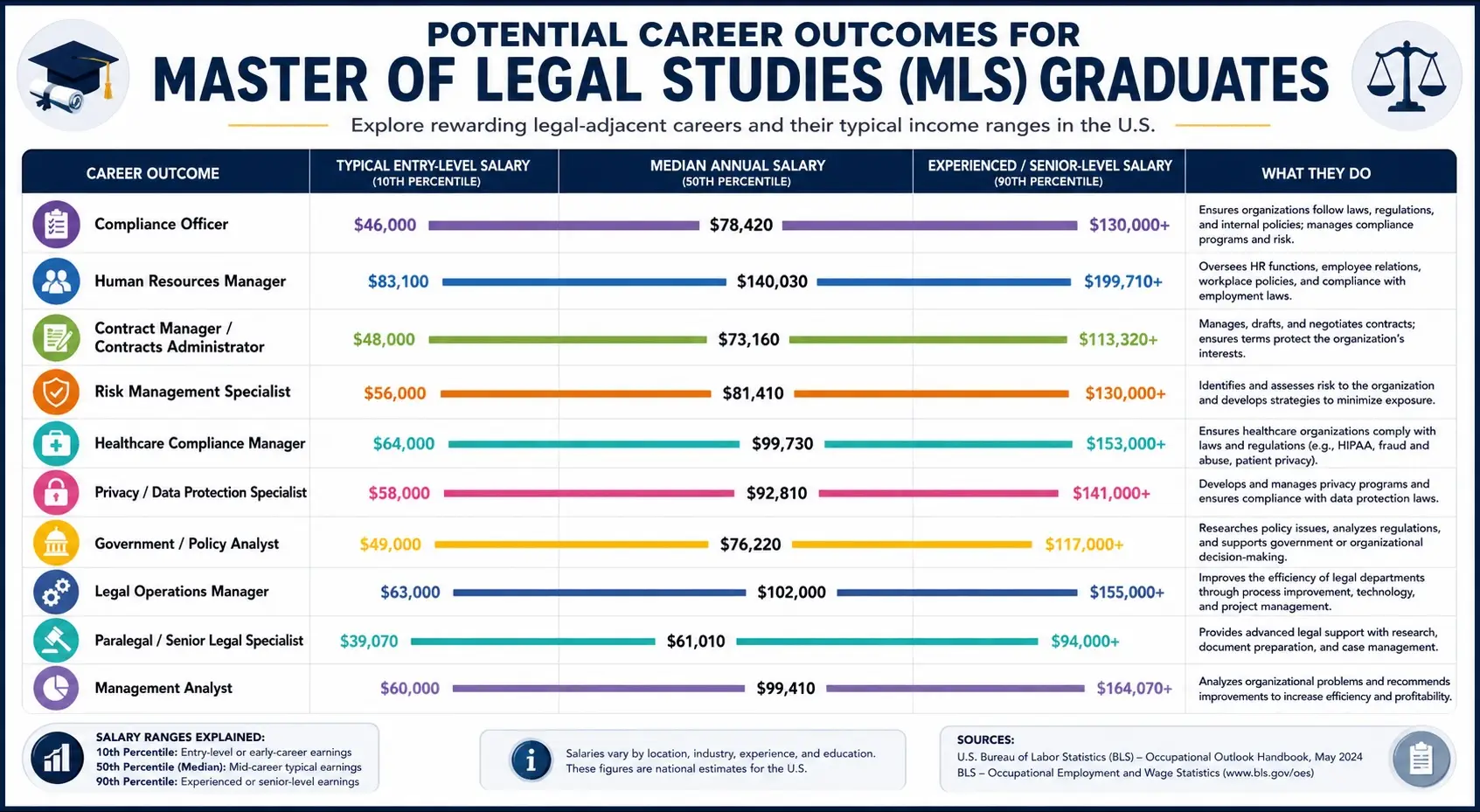
The employment outlook supports that need. According to the U.S. Bureau of Labor Statistics, employment of human resources managers is projected to grow 5% from 2024 to 2034, with a median annual wage of $140,030 as of May 2024. Human resources specialists are projected to grow 6% over the same period, with a median wage of $72,910. Compensation and benefits managers earned a median annual wage of $140,360 in May 2024, though that occupation is projected to show little or no employment growth from 2024 to 2034.
LegalDegree.org focuses on educational guides that help students choose the right legal degree and law school, with emphasis on ranking programs, explaining the purpose of the degree, and discussing the industry as a whole. The project guidance also prioritizes the American Bar Association and BLS as authoritative sources, followed by well-researched reports and school materials.
Why HR Professionals Consider an MLS
An MLS in human resources or employment law can help HR professionals better understand the rules that shape the employee lifecycle. These programs commonly cover hiring and firing, workplace investigations, employee privacy, labor relations, compensation, benefits, discrimination, harassment, leave, workplace safety, and compliance.
For HR professionals, the value is not in becoming a lawyer. The value is in becoming a more legally literate business leader. Graduates may be better prepared to work with in-house counsel, evaluate risk, draft and apply workplace policies, respond to employee complaints, manage investigations, and advise leadership on legally sensitive workplace decisions.
The Value of SHRM Certification
The Society for Human Resource Management, or SHRM, offers two major HR credentials: SHRM Certified Professional, or SHRM-CP, and SHRM Senior Certified Professional, or SHRM-SCP. SHRM describes these credentials as designed for individuals performing HR-related duties or pursuing a career in human resources.
For MLS students and HR professionals, SHRM certification can add a recognized HR credential to a legal studies education. An MLS may strengthen legal and regulatory knowledge, while SHRM certification can validate applied HR competencies. Together, they can signal both legal fluency and HR-specific professional readiness.
A SHRM-aligned or SHRM-endorsed program can be especially valuable because it indicates that the curriculum has been reviewed against SHRM’s HR curriculum standards. SHRM says its academic alignment process is intended to help degree programs align with SHRM’s HR Curriculum Guidelines, and SHRM’s curriculum materials emphasize preparing HR students through business-context HR education based on the SHRM Body of Applied Skills and Knowledge.
Important note: SHRM alignment does not automatically award SHRM certification. Students generally still need to apply for and pass the SHRM-CP or SHRM-SCP exam. However, a SHRM-aligned legal master’s program may provide structured preparation and, in some cases, may help students qualify or prepare to sit for the exam.
Top 5 MLS Programs for Human Resources Professionals
1. Arizona State University — Master of Human Resources and Employment Law
School: Sandra Day O’Connor College of Law
Degree: Master of Human Resources and Employment Law
Format: Online or in person
Best for: HR professionals who want a law-school-based HR degree with SHRM alignment
Arizona State University’s Master of Human Resources and Employment Law is one of the strongest options for HR professionals who want a specialized legal master’s degree built around workplace law. Although the degree title is not simply “MLS,” it is a non-JD legal master’s offered through ASU Law and designed for HR, recruitment, and operations professionals who want legal expertise without becoming attorneys.
ASU stands out because its program is directly tied to HR and employment law rather than offering HR as just one concentration within a broader legal studies degree. The curriculum is designed to help students understand the legal and regulatory structures that shape employment-related challenges across organizations. ASU Online notes that students study areas including compensation, benefits, labor, job analysis, and talent management.
ASU is also notable for SHRM alignment. The university states that ASU Law was recognized as the first law school fully aligned with SHRM curriculum guidelines, and that this alignment allows enrolled students to apply for the SHRM certification professional exam. ASU also states that earning SHRM certification is an important distinction recognized by many employers in hiring and promotion.
Why it ranks highly: ASU offers one of the clearest bridges between legal education, HR practice, and SHRM certification preparation.
2. UCLA School of Law — Master of Legal Studies: Employment & Human Resources Law
School: UCLA School of Law
Degree: Master of Legal Studies
Specialization: Employment & Human Resources Law
Format: Online, hybrid, or on campus
Best for: HR professionals who want a prestigious law school brand and a broad employment law curriculum
UCLA School of Law’s Master of Legal Studies with a specialization in Employment & Human Resources Law is designed specifically for HR professionals seeking to advance their careers. The program covers major workplace law subjects such as employment law, discrimination, compensation, labor relations, and data privacy.
UCLA’s MLS is also built for working professionals and full-time students, with online, hybrid, and on-campus options. The broader MLS program is designed to help professionals understand complex legal issues, navigate regulations, work with lawyers, and manage disputes or legal interactions in business, nonprofit, and government settings.
For HR professionals, UCLA’s value comes from the combination of law school reputation, flexible format, and employment-focused legal coursework. The program is especially attractive for professionals who want a legal studies degree from a nationally known law school and who may be working in large organizations, public agencies, entertainment, higher education, healthcare, or other heavily regulated workplaces.
Why it ranks highly: UCLA offers one of the most recognizable MLS programs with a dedicated Employment & Human Resources Law specialization.
3. University of Pittsburgh School of Law — Master of Studies in Law: Human Resources Law
School: University of Pittsburgh School of Law
Degree: Master of Studies in Law
Specialization: Human Resources Law
Format: Online
Best for: HR professionals who want an online SHRM-aligned legal studies program
The University of Pittsburgh School of Law offers an online Master of Studies in Law with a specialization in Human Resources Law. Pitt describes the online MSL as a 30-credit advanced degree for professionals, with specializations including Human Resources Law, Corporate Compliance, Health Care Compliance, International Business Law, and Sports, Entertainment, and Arts Law.
Pitt’s HR Law specialization is especially relevant because the school states that the program is aligned with the SHRM HR Curriculum Guidebook and Templates.
The program is a strong fit for HR professionals who want a flexible online degree that connects legal training to day-to-day workplace responsibilities. Pitt’s HR Law certificate materials emphasize that employment law knowledge is becoming essential for HR tasks such as administering benefits, handling employee relations issues, ensuring workplace safety, and managing sensitive workplace matters.
Why it ranks highly: Pitt combines online flexibility, a law-school-based MSL, and SHRM-aligned HR law coursework.
4. Wake Forest University School of Law — Online MLS in Human Resources
School: Wake Forest University School of Law
Degree: Master of Legal Studies
Track: Human Resources
Format: Online
Best for: Working HR professionals who want a part-time legal studies program with practical workplace applications
Wake Forest University School of Law offers an online Master of Legal Studies with a Human Resources track. The program is designed for professionals who need to understand how law applies in the workplace, especially in areas such as compliance, risk management, employee relations, disputes, benefits, and employment-related decision-making.
The MLS is a 30-credit program that includes 13.5 credits of required core curriculum, 10.5 or more credits in Human Resources track courses, and up to 6 credits of electives. Wake Forest identifies the HR track as relevant for human resource directors and managers, benefits and compensation professionals, talent acquisition leaders, employee relations professionals, HR generalists, business owners, consultants, policymakers, and advocates.
Wake Forest also emphasizes flexible online study for working professionals. Its online MLS can be completed on a part-time schedule and is designed to provide rigorous legal education without disrupting professional responsibilities.
Why it ranks highly: Wake Forest offers a well-structured online MLS with a dedicated HR track and practical legal learning outcomes for professionals.
5. Northeastern University School of Law — Online MLS in Human Resources Law
School: Northeastern University School of Law
Degree: Master of Legal Studies
Concentration: Human Resources Law
Format: Online
Best for: HR professionals who want a practical, fully online MLS with strong workplace compliance coverage
Northeastern University School of Law offers an online Master of Legal Studies with a concentration in Human Resources Law. The HR Law concentration focuses on topics such as employment discrimination, wage-and-hour laws, workplace safety regulations, employee benefits administration, and labor relations.
Northeastern’s broader online MLS is designed for non-lawyer professionals who work with lawyers and legal issues. The school notes that the degree is intended for professionals in highly regulated industries who want to gain legal knowledge without earning a JD.
For HR professionals, Northeastern’s strength is its practical concentration model. Students first build a general legal foundation, then focus on legal issues in their industry through electives and concentration coursework. The program is particularly useful for HR professionals who want to move from simply following HR policies to helping design, interpret, and improve them.
Why it ranks highly: Northeastern offers a practical online MLS with targeted HR law coursework and a strong fit for compliance-minded HR professionals.
Other Strong Programs to Consider
Several other legal master’s programs may also be good fits for HR professionals:
Drexel University Thomas R. Kline School of Law — MLS in Human Resources Compliance
Drexel’s MLS in HR Compliance prepares students for legal responsibilities in HR offices and includes coursework in hiring and termination, managing the employer-employee relationship, negotiation, mediation, and alternative dispute resolution.
St. Mary’s University School of Law — MLS in Employment and Human Resource Law
St. Mary’s offers an MLS concentration in Employment and Human Resource Law designed to help professionals understand workplace legal issues and risk management.
Florida State University College of Law — Juris Master in Employment Law and HR Risk Management
FSU’s Juris Master’s is a 30-credit online master’s in legal studies designed for HR professionals seeking legal training in employment law and HR risk management.
Trinity Law School — MLS in Human Resources Management
Trinity states that its MLS in Human Resources Management is aligned with SHRM curriculum guidance and that MLS students may be eligible for SHRM student membership and potentially apply to sit for the SHRM-CP exam.
Career Outlook for HR Professionals With Legal Training
HR professionals with legal training may be especially valuable in organizations where workplace compliance is a major concern. Common career paths include:
- Human Resources Manager
- Employee Relations Manager
- Labor Relations Specialist
- Compensation and Benefits Manager
- HR Compliance Manager
- Talent Acquisition or Recruiting Director
- Training and Development Manager
- Workplace Investigations Specialist
- Diversity, Equity, and Inclusion Compliance Lead
- Chief People Officer or HR Director
Salary varies by title, location, employer, and experience. BLS data shows that human resources managers and compensation and benefits managers both had median wages of around $140,000 in May 2024, while HR specialists earned a median wage of $72,910.
For professionals who already work in HR, an MLS may be most valuable when paired with experience and certification. The degree can help strengthen legal literacy, while SHRM-CP or SHRM-SCP certification can validate HR-specific knowledge and competencies.
How to Choose the Right MLS Program for HR
When comparing MLS programs for human resources professionals, consider the following:
SHRM alignment: If SHRM certification is part of your plan, look closely at whether the program is SHRM-aligned and whether it helps prepare students for SHRM-CP or SHRM-SCP.
Curriculum fit: Prioritize programs with coursework in employment law, discrimination, wage and hour law, benefits, labor relations, investigations, privacy, and workplace compliance.
Format: Many HR professionals need part-time or online study. Confirm whether the program is fully online, hybrid, asynchronous, or campus-based.
Law school reputation: A recognizable law school may help signal academic rigor, especially if you plan to move into senior HR, compliance, or employee relations roles.
Career goals: Some programs are more compliance-focused, while others emphasize leadership, labor relations, policy, or general legal literacy.
Conclusion
The best Master of Legal Studies programs for human resources professionals combine legal training with practical workplace application. ASU, UCLA, Pitt, Wake Forest, and Northeastern stand out because they offer focused HR or employment law pathways designed for non-lawyer professionals.
For HR professionals, an MLS can be a strategic credential. It may help them better manage legal risk, communicate with attorneys, draft and interpret policies, lead investigations, and advise organizations on complex workplace issues. When paired with SHRM certification, the degree can become even more powerful: one credential strengthens legal knowledge, while the other validates professional HR competence.
Similar Resources
10 Career Outcomes for Graduates with a Master of Legal Studies
Sources
U.S. Bureau of Labor Statistics – Human Resources Managers
U.S. Bureau of Labor Statistics – Human Resources Specialists
U.S. Bureau of Labor Statistics – Compensation and Benefits Managers
Society for Human Resource Management – SHRM Certification
Society for Human Resource Management – SHRM Certification for Educators
ASU Online – Master of Human Resources and Employment Law
Arizona State University Degree Search – Human Resources and Employment Law, MHREL
UCLA School of Law – MLS Specialization in Employment & Human Resources Law
UCLA School of Law – Master of Legal Studies
University of Pittsburgh School of Law – Online MSL in Human Resources Law
University of Pittsburgh School of Law – Online Master of Studies in Law
Wake Forest University School of Law – Online MLS Human Resources Track
Wake Forest University School of Law – Online Master of Legal Studies
Northeastern University School of Law – MLS in Human Resources Law
Northeastern University – Master of Legal Studies
Drexel University Thomas R. Kline School of Law – MLS in Human Resources Compliance
St. Mary’s University School of Law – MLS in Employment and Human Resource Law
Florida State University College of Law – Juris Master in Employment Law and HR Risk Management